
Magnate / Operator guide / October 2026
Brokering dumpster orders.
Sell the sizes you don’t own yet, prove the demand, then buy the equipment.
Find your brokering model
The opportunity
You don’t need to own every size to serve more customers.
Most dumpster companies run two or three sizes. When a customer asks for something you don’t carry, that call can become somebody else’s order.
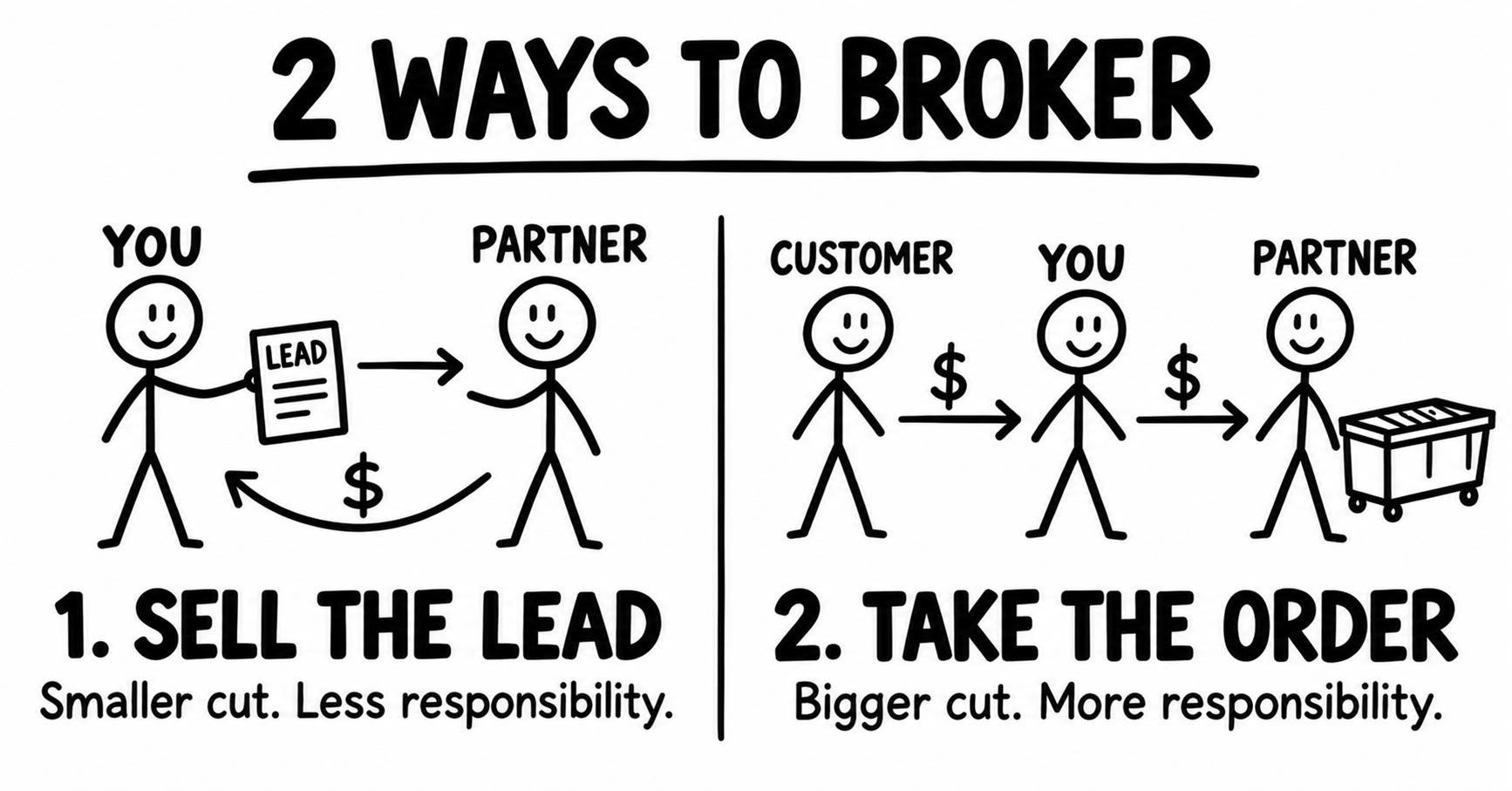
Brokering gives you another option: work with a nearby hauler who already owns the equipment. Refer the lead for a fee, or take the order yourself and hire that partner to fulfill it. You can earn on work you would otherwise turn away and collect real demand data before investing in more cans or a bigger truck.
The short version: brokering is a risk dial.
Selling the lead generally means less responsibility and a smaller cut. Taking the order puts more of the margin, and more of the responsibility, in your hands. Both depend on reliable partners and clear paperwork.
01 / Why broker
Get the data before you buy the equipment.
Test a new size.
If your biggest can is a 27-yard, partner with someone who runs 30s and 40s. Confirm their capacity before offering those sizes, then track the orders. The same approach works for smaller cans.
Build demand first.
When it’s time to buy, you have a booking history and customers asking for those sizes. Your next equipment decision has evidence behind it.
Keep a good lead working.
A request for a size you don’t run can produce revenue instead of ending with “we don’t have that.”
Stay the point of contact.
When you take the order, your business manages the customer relationship. Agree with your partner on how repeat requests come back through you.
02 / Two ways to broker
Choose how much of the order you want to own.
The same customer request can lead to two very different arrangements. Decide who takes payment, who handles the customer, and how you get paid before sending the job.
Option 1
Sell the lead.
You send the lead to a trusted partner. They book it, take payment, handle the paperwork, and pay you an agreed fee.
What you gain- The partner handles the customer’s payment and chargebacks.
- Less scheduling, paperwork, and fee management.
- A simple way to test a new partner.
- A defined fee for the lead you deliver.
- A smaller cut than the full rental spread.
- Control over when the partner pays you.
- You depend on accurate lead reporting.
- The partner handles the booking and customer relationship.
Option 2
Take the order.
The customer books and pays you. You hire a partner at an agreed rate, manage fulfillment, and keep the difference after costs.
What you gain- You set the customer price and rental spread.
- You collect payment through your booking process.
- You can earn on disclosed overage rates.
- You manage the booking and repeat business.
- Late deliveries, no-shows, and customer complaints.
- Partner fees for weight, extra days, or damage.
- Refunds and chargebacks.
- The need for clear customer and partner agreements.
Start with trust, then add responsibility. Use the lead model to test a new partner. Move to taking orders once you know they deliver reliably and your agreements are in place.
03 / Approval-first booking
Confirm the dumpster before you confirm the order.
A customer requests a 40-yard. Your partner is out of 40s. Two 20s may work, but only if the customer agrees. Build a confirmation step into your workflow so a request doesn’t promise equipment you can’t deliver.
- Customer requests a dumpster.
Make the requested size, dates, address, and materials clear. - Confirm with your partner.
Check the size, delivery window, rental period, and agreed rate. - Approve the order.
Confirm the customer terms and payment before dispatch. - Pay within the agreed scope.
A single-use or spend-limited virtual card can control the card transaction. It does not cancel legitimate fees owed under your agreement. - Deliver and document.
The partner handles the haul. You keep the customer informed and collect the proof.
Check your software’s payment settings. If you use iCANS or another booking platform, confirm how approval, authorization, capture, declines, and processing fees work in your account. Don’t assume a declined request always means no charge or fee.
04 / The service agreement
Cover their terms, not just yours.
When you hire the hauler, you are the customer they bill. If a partner charges for overweight, extra days, or a prohibited item, your customer terms need to address those charges before the order is accepted.
- Collect the paperwork first. Get every partner’s service agreement and current fee sheet before sending an order.
- Map the possible charges. Included tonnage, overage per ton, rental extensions, swaps, prohibited items, trip fees, and property damage all need attention.
- Get customer acceptance at booking. Clearly disclose the applicable rates and conditions. Keep the accepted agreement with the order.
- Have an attorney review it. Make sure the final customer and partner agreements fit your operation before using them.
Don’t discover a fee after the fact. Your quote, your customer’s agreement, and your partner’s fee sheet should tell a consistent story.
05 / Partner compliance
Proof on every order.
No exceptions.
Your partner is delivering under your name. Set the same documentation standards you would expect from your own driver.
At delivery
Drop-off photos
Show the dumpster in place, its position on the property, and the condition of the driveway or surface. Get the photos before the driver leaves.
At pickup
Load and site photos
Capture the load level before hauling and the site after the can is gone. These records help resolve questions about overfill, prohibited materials, and damage.
After disposal
The scale ticket
Get the landfill receipt on every haul. Use it to verify the partner’s weight charge and support any customer overage bill.
Make compliance part of the relationship. If a partner won’t send the agreed photos and tickets, don’t send the next order.
06 / Pricing
Know your spread.
Protect your margin.
Availability, responsiveness, and trust have value. Know your fulfillment cost before quoting, and decide the minimum margin that makes the job worthwhile.
“I’ve brokered orders at double what I paid, and customers paid it because they needed it done ASAP and trusted who they booked with.”Dave Grissom / experience shared in this guide, not a promised result
- Price the rental deliberately. Know the partner’s rate and your other costs. If the job doesn’t leave your required margin, decline it or change the quote.
- Disclose your overage rate. The customer pays the rate they accepted, and you pay the partner’s agreed rate. Support the weight calculation with the scale ticket.
A simple example / illustrative only
- Customer rental price
- $650
- Partner rental cost
- − $450
- Rental spread
- $200
07 / Protect the relationship
Build a bench of partners you can count on.
- Agree on repeat orders. In the take-the-order model, make it clear that your customer’s next request comes back through you. The partner gets paid to fulfill that order too.
- Set expectations about direct selling. Discuss customer ownership and undercutting on day one. If the arrangement isn’t respected, use a different partner.
- Line up two or three haulers. Have alternatives for the sizes you don’t carry. One unavailable partner shouldn’t end every opportunity.
- Pay on time. Reliable payment helps build a working relationship that lasts.
08 / Getting started
Your first brokered order starts here.
- Build the shortlist.Find two or three haulers in your service area who run the sizes you don’t.
- Get the facts.Collect rates, availability, service agreements, and fee sheets.
- Choose your model.Start new partners with lead referrals. Take orders yourself once trust and the agreements are in place.
- Set the proof standard.Require drop-off photos, pickup photos, and a landfill ticket on every haul.
- Track every order.Record size, date, ZIP code, price charged, partner cost, other costs, and margin.
- Set your buying threshold.Decide what monthly volume would justify owning those sizes and the truck to haul them. Review the data every quarter.
Start small. Learn from real orders.
Pick partners carefully, get the paperwork right, and let the demand tell you when it’s time to buy.
Shout out to Matt Ferguson of Prime Dumpster Rentals for asking the question that started this guide.